
Tangrams
Tangrams are a fantastic tool for promoting spatial awareness, problem-solving, and creativity.
Tangrams
Tangrams are a fantastic tool for promoting spatial awareness, problem-solving, and creativity. Here's an activity guide for using tangrams to enhance spatial awareness:
1. Gather materials:
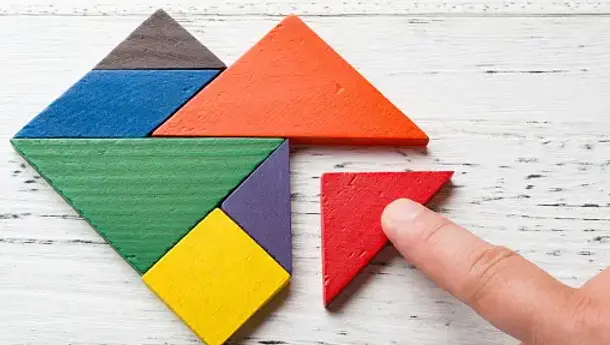
Collect a set of tangram puzzles or create your own by cutting out seven geometric shapes from paper or cardboard. The shapes typically include two large triangles, one medium triangle, two small triangles, one square, and one parallelogram.
2. Set up the space:
Create a designated area where participants can work with the tangrams. Ensure that the space is clear and provides enough room for participants to arrange the shapes comfortably.
3. Demonstrate tangram puzzles:
Show participants how to arrange the tangram shapes to form different figures or patterns. Start with simple examples, such as a square or a triangle, and gradually introduce more complex designs.
4. Freeform tangram play:
Encourage participants to explore their creativity and spatial awareness by arranging the tangram shapes freely. They can experiment with different combinations, patterns, and designs. Encourage them to think about symmetry, balance, and spatial relationships as they arrange the shapes.
5. Tangram challenges:
Introduce specific challenges to further develop spatial awareness. For example, participants can try to recreate specific figures or objects using the tangram shapes. You can provide pictures or cards with the desired designs for them to replicate. These challenges encourage problem-solving and critical thinking.
6. Collaborative tangram play:
Encourage participants to collaborate and work together on a joint tangram project. They can take turns arranging the shapes to create a shared design or work on separate designs that can be combined later. This promotes teamwork and social interaction.
7. Reflect and share:
Gather participants to reflect on their tangram experience. Discuss the challenges they faced, the strategies they used, and the spatial awareness skills they developed. Encourage them to support and appreciate each other's creations.
8. Extension activities:
To further enhance spatial awareness, participants can engage in additional activities such as creating their own tangram designs, solving tangram puzzles with time challenges, or using tangrams to explore symmetry and transformations. These activities encourage imagination and deeper exploration of spatial concepts.
9. Clean-up:
Guide participants in cleaning up the tangram shapes and returning them to their proper storage. Encourage them to take care of the shapes and keep the area tidy.
10. Reflect and share:
Gather participants once again to reflect on their overall experience with tangrams. Discuss the skills they developed, the creativity they expressed, and any insights they gained from the activity.
Tangrams provide a wonderful opportunity for spatial awareness, problem-solving, and creativity. Enjoy the process of arranging the shapes and encourage participants to explore their spatial thinking and design skills!